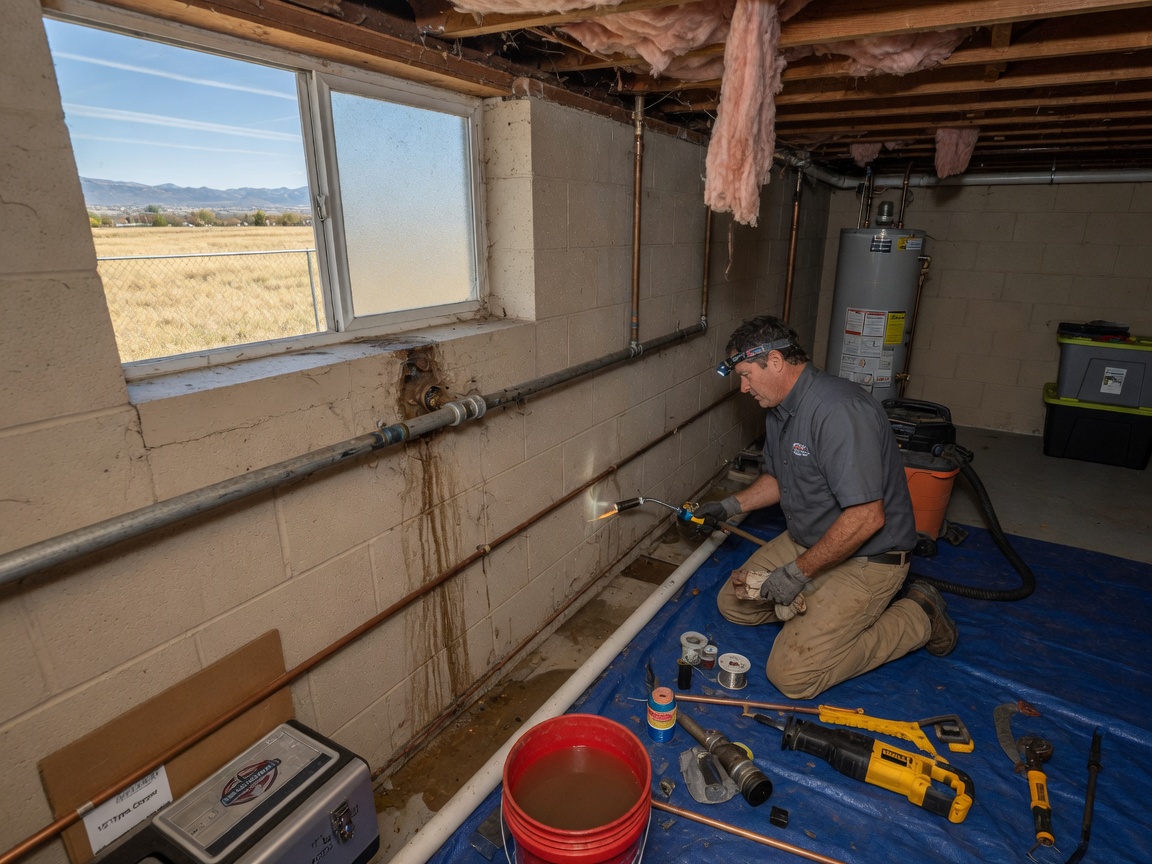
Harvest Ridge is a subdivision of single-family homes in east Thornton around E 100th and E 102nd Avenues, ZIP 80229. Most were built from the mid 1990s into the early 2000s. That is old enough for wear to show in water heaters, shutoff valves and the sewer line buried under the yard.
Thornton's water is hard, averaging about 200 mg/L and swinging from roughly 140 in winter to 250 in summer. Scale settles as sediment on the bottom of a tank. Rumbling or popping when the heater runs, hot water that runs out early, or damp ground at the bottom of the tank points to a tank worn out by sediment and a spent anode rod. If water is at the bottom of the tank, shut the cold supply on top of the tank and the gas or power, then call. A leaking tank means water heater replacement. A heater that only stopped heating may be a water heater repair.
Front Range soil around Thornton often contains expansive clay that swells when wet and shrinks when dry. Over decades that movement can leave a low spot in a sewer line or open a joint, and roots find the gap. The sign is usually the lowest level: a floor drain or shower that gurgles or backs up, or a drain that clears and slows again within weeks. Stop running water and do not flush. We run a camera through the line before recommending any digging, and sewer line repair is what follows if the pipe itself is the problem.
Call when water is spreading, sewage is coming up, or the house has no hot water in a cold snap. Our phone line is open Monday to Saturday, 9am to 6pm. We explain what we find and put a written scope and price in front of you to approve before work begins. (720) 856-5811.
Around Harvest Ridge
We regularly work near:
- 📍E 100th Avenue
- 📍York Street
- 📍Margaret W. Carpenter Recreation Center (about 2.5 miles away)
- 📍Carpenter Park
Plumber in Harvest Ridge · Local Notes
- •Homes date mostly from the mid 1990s to the early 2000s, so water heaters, shutoff valves and supply fittings are well into their service life.
- •Thornton Water reports hardness averaging about 200 mg/L (11.7 grains per gallon), from about 140 in winter to 250 in summer, which builds scale and sediment in tank water heaters.
- •Expansive clay is common in Front Range soil, according to the Colorado Geological Survey, and as it swells and shrinks it can shift buried sewer lines and open joints over time.
- •Lots run from about 6,000 square feet to a fifth of an acre, with 2-story, multi-level, ranch and tri-level layouts. A floor drain or bath on the lowest level is where a main line backup shows first.