2026-08-29 ·
What Drives Water Heater Repair Cost in Thornton
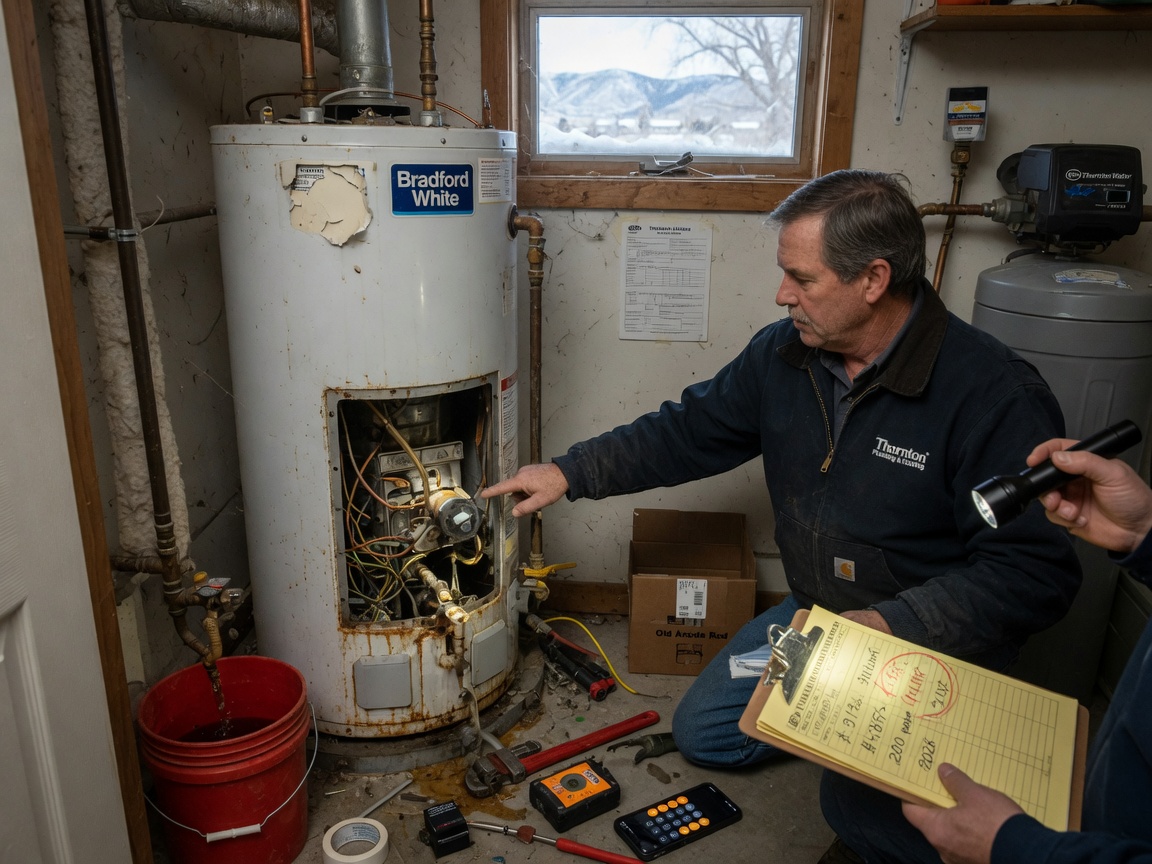
What You'll Notice First
Water heater trouble usually shows up as one of a few signs: no hot water at all, hot water that turns lukewarm and runs out after a few minutes, rumbling or popping from inside the tank, a pilot light that won't stay lit, water pooling on the floor under the unit, or a rotten-egg smell coming from the taps. Each of these points to a different part, and the part that failed is the single biggest factor in what a repair involves.
What's Usually Behind It
On electric tank units, a failed heating element or thermostat is the most common cause of no hot water or water that turns cold soon after it heats. On gas units, a failed thermocouple or gas control valve often keeps the pilot from staying lit. Sediment settling on the bottom of the tank can insulate the lower element, cause popping or rumbling sounds, and shorten the life of the parts near it. A spent anode rod lets corrosion start inside the tank. A failed temperature and pressure relief valve, or one that's dripping, is a safety part, not something to ignore. Tankless units have their own failure points: scale buildup inside the heat exchanger from minerals in the water, or a failed flow sensor that keeps the unit from firing.
What to Do Right Away
If the tank is leaking, shut the cold water supply valve on top of the unit and turn off power at the breaker, or set a gas unit's control to pilot or off. Never cap, plug, or tie down a dripping temperature and pressure relief valve. That valve is releasing pressure on purpose, and blocking it is dangerous. If you smell gas anywhere near the unit, leave the area and call your gas utility before calling anyone else. For anything beyond flipping a breaker or a valve, stop and call a plumber.
What Changes the Cost of a Repair
There's no single number that applies to every water heater, because several things change what the job actually involves:
- Which part failed. A thermostat or thermocouple is a smaller job than a heat exchanger or control board.
- Tank versus tankless. Tankless units have more electronics and sensors, which usually means more diagnostic time.
- Gas versus electric. Gas work sometimes touches venting or the gas line itself, which adds steps.
- Access. A unit in an open utility room is easier to work on than one wedged into a tight closet, an attic, or a crawl space.
- Whether venting or gas line work is needed alongside the repair.
- Whether the job needs a permit.
Because of all this, the only way to get a firm number for your situation is a diagnosis. A plumber should look at the unit, identify the failed part, and give you a written scope that lists the parts and the labor involved, for you to approve before any work starts.
Repair or Replace
Some problems are straightforward water heater repairs: a failed heating element, thermostat, thermocouple, gas control valve, or relief valve can usually be replaced without replacing the whole unit. A tank that's actively leaking from its body, rather than from a fitting or valve, generally can't be repaired, because the tank itself has failed, and that means water heater replacement. Heavy corrosion around the base points the same direction. Age matters too: check the manufacture date on the rating plate on the side of the tank, and weigh a repair against how much life the unit likely has left. Tankless units tend to hold up longer overall, and problems with sensors or flow are usually fixable rather than a reason to replace the whole unit.
Mineral content in the water also plays a role over time. Scale builds up inside tanks and tankless heat exchangers, which is part of why periodic flushing is worth doing regardless of which type you have.
Permits and Local Rules
Replacing a water heater, or changing gas lines or venting as part of a repair, generally needs a permit from your local building department. For most Thornton addresses that's the City of Thornton, though it's worth confirming with them directly since requirements can vary by address. A plumber doing the work can tell you whether your specific repair triggers a permit.
Choosing Someone to Do the Work
Ask for a written scope of work before anything starts, and be wary of anyone who pushes you toward full replacement without first explaining what's actually failed and why a repair isn't an option.
More guides
- Drain Cleaning vs. Hydro Jetting in Thornton
- Burst Pipes and Freeze Risk on the Front Range
- Clogged Drain or Sewer Line: How Thornton Homeowners Can Tell
If your water heater is acting up in Thornton, call (720) 856-5811, Monday to Saturday, 9am to 6pm.