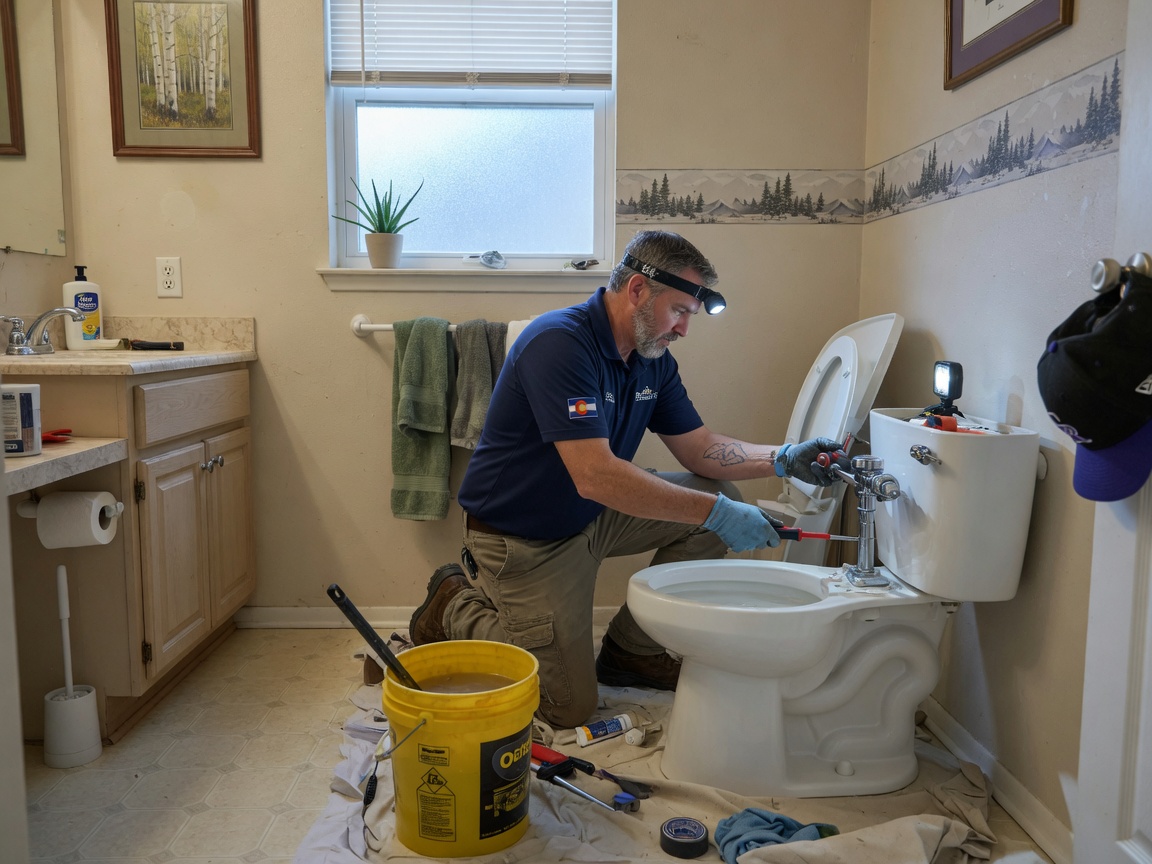
Toilet repair in Thornton covers everything from a toilet that runs constantly to one that rocks, leaks at the base, or will not flush properly. Most of these trace back to a handful of parts inside the tank or under the bowl. If your toilet is overflowing or leaking steadily, the first move is to turn the stop valve behind the toilet clockwise to shut off its water supply.
Why does my toilet keep running?
A running toilet almost always comes from one of four parts: the flapper, the fill valve, the float height, or the chain connecting them. A worn flapper does not seal fully and lets tank water leak into the bowl, which the fill valve then keeps topping up, so the toilet never really stops. A float set too high sends water into the overflow tube. A chain that is too long, or has slipped off the hook, does the same thing by holding the flapper open just enough. Most of the time this is a straightforward flapper or fill valve swap once we see which part is actually failing.
If your toilet flushes itself every so often with no one in the room, that is usually a flapper leaking slowly enough that the tank has to top itself back up on its own, sometimes called phantom flushing, and the fix is the same worn flapper.
Toilet not flushing properly
A weak or partial flush usually comes down to one of three things: a partial clog past the trap, a low water level in the tank, or rim jets clogged with mineral scale that keep water from washing the bowl clean. Check the tank water level first; if it sits well below the fill line marked inside the tank, the fill valve needs adjusting. If the water level looks normal but the flush still will not clear the bowl, the rim jets or the trap are the more likely cause.
Leaking at the base
Water on the floor around the base usually means the wax ring under the toilet has failed and is no longer sealing the connection to the drain. Loose closet bolts let the toilet shift slightly with every use, which breaks that seal faster. A cracked or rusted flange, the fitting the toilet bolts to, is the more involved version of the same problem and needs its own repair before a new wax ring will hold. A leak from where the tank meets the bowl instead of the floor points to a different, simpler fix: a worn tank-to-bowl gasket or loose mounting bolts.
Rocking or unstable toilet
A toilet that rocks side to side usually means the closet bolts have loosened or the wax ring seal underneath has started to fail, either of which lets the base shift instead of sitting flat. Do not keep using a rocking toilet for long; the movement wears the wax ring further and can crack the flange or the bowl itself. Tightening the bolts evenly, without overtightening, sometimes buys a little time, but a toilet that keeps rocking after that needs the flange and seal checked properly.
Fix it or replace the toilet?
Most toilet problems are repairable: flappers, fill valves, wax rings, and flanges are all standard parts. Replacement becomes the better option when the bowl or tank itself is cracked, when the flange is too damaged to hold a new wax ring, or when an older toilet has failed the same way more than once. When you call, tell us what you are seeing (running, weak flush, water at the base, rocking), how long it has been happening, and whether the stop valve is already shut off. We ask a few more questions, take a look, explain what we found, and give you a written scope and price to approve before any work starts.
Related work we do in Thornton: clogged drain repair and water leak repair.
Call (720) 856-5811 and tell us what your toilet is doing; we will walk you through what to check before anyone comes out.
Technician insight
In older South Thornton bathrooms we see wax rings dry out and flanges rust well before homeowners notice, since the first sign is often a toilet that rocks slightly rather than obvious water on the floor. In newer North Thornton homes the more common call is a fill valve or flapper that simply wore out.
A common call
Say your toilet has started running every few minutes even though nobody has flushed it, and turning the stop valve behind it clockwise stops the sound right away. That points to a flapper or fill valve that is not sealing rather than anything bigger. Before calling, note how the tank water looks when you lift the lid and whether the chain looks slack or disconnected, since that tells us what to check first.
Toilet Repair Services We Offer
✓Running Toilet Repair
Replaces a worn flapper, fill valve, or float, or resets a chain that is holding the flapper open, to stop water running constantly.
✓Weak or Partial Flush Repair
Clears clogged rim jets or a partial clog in the trap, or adjusts a tank water level that is sitting too low.
✓Toilet Flange Repair
Repairs a cracked or rusted flange and replaces the wax ring where a toilet leaks at the base or rocks.
✓Tank-to-Bowl Leak Repair
Replaces the gasket and mounting bolts where the tank meets the bowl.
✓Toilet Replacement
Removes a cracked bowl or tank, or a toilet that keeps failing the same way, and installs a new unit on the existing flange.
✓Tank Parts Repair
Fixes chains, levers, fill valves, and other tank components that wear out with regular use.
How it works
- 1
Phone Assessment
We ask what the toilet is doing, whether water is at the base, and whether the stop valve is already shut off.
- 2
On-Site Diagnosis
We check the flapper, fill valve, float, flange, and wax ring to find what has actually failed.
- 3
Explain and Approve
We explain what we found and give you a written scope and price before starting any work.
- 4
Repair and Test
We complete the repair, then run several flush cycles and check the base for leaks before we consider it done.
Pricing
Toilet repair cost depends on which part has failed and whether the flange or bowl needs more than a simple part swap. We explain what we find and give you a written scope and price to approve before any work starts.