2026-09-30 ·
Tank or Tankless Water Heater for a Thornton Home?
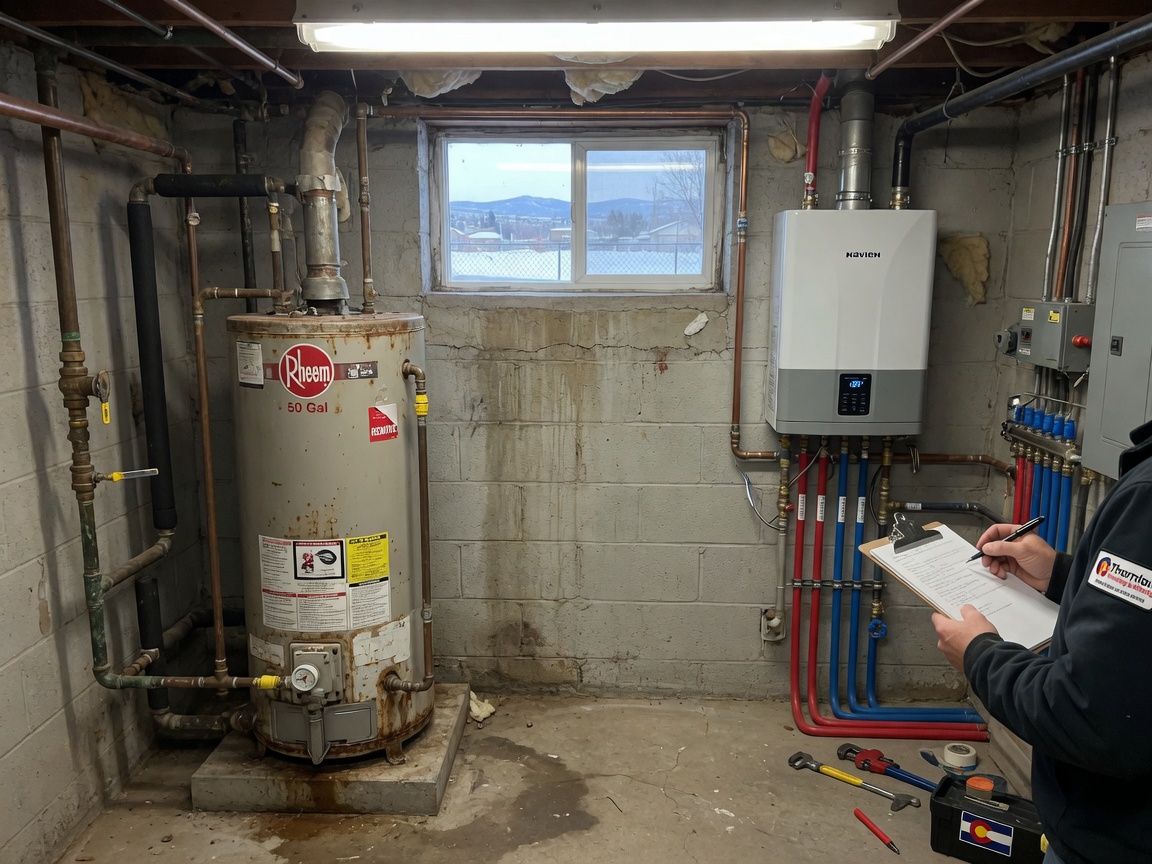
Your water heater is failing or has failed, and someone has told you to think about going tankless. Before you decide, it helps to know what each type does, what Thornton's water and climate do to it, and what a switch can pull in. If the unit is only leaking or acting up and you have not settled on replacing it, start with water heater repair and the repair cost breakdown. If you already know it is done, keep reading.
How each one works
A tank heater keeps 40 to 50 gallons or so of water hot all day. A burner or electric elements heat the water, an insulated shell holds it, and when you open a tap, hot water leaves the top and cold water refills the bottom. You can run out, but the next person in line only waits for the tank to recover. A tankless heater has no stored water. When a hot tap opens, flow starts the burner or elements, and water is heated as it passes through a heat exchanger. Hot water does not run out, but the unit can only heat so many gallons per minute. Run a shower, the dishwasher and a washing machine at once and the flow limit shows up as lukewarm water.
Thornton's hard water
The City of Thornton reports hardness averaging about 200 mg/L (roughly 11.7 grains per gallon), from around 140 in winter to around 250 in summer, and the city does not soften it ([thorntonwater.com](https://www.thorntonwater.com)). In a tank, those minerals settle as sediment on the bottom and bake onto the lower element or burner surface. Symptoms are popping or rumbling, longer recovery, and a tank that dies early. Draining a few gallons from the valve each year and checking the anode rod slows that down. In a tankless unit, the same minerals coat the inside of the heat exchanger as scale. Stiebel Eltron says scale cuts heat transfer, narrows the water passages and causes uneven temperatures, and suggests descaling once a year for moderately hard water and every 6 to 9 months for very hard water. The Building America Solution Center says manufacturers recommend a professional yearly cleaning of the heat exchanger with a mild acid solution. One A. O. Smith on-demand manual we read sets a limit of 7 grains per gallon for single-family use, and Thornton's average is above that. Check the limits printed in the manual for any model you are considering, and ask what the manufacturer expects for water this hard. A tankless unit in Thornton is a heater you plan to descale on a schedule, or one you protect with water treatment.
Winter water and altitude
A tankless heater raises the temperature of the water coming in. In January that water is colder than in August, so the unit has to add more heat, and at the same setpoint it can deliver fewer gallons per minute. The Building America guidance says to size a unit using the winter cold water temperature and your desired hot temperature, not summer numbers. A tank feels this too, as slower recovery, but it has a reserve to lean on. Altitude matters for gas units. Thornton sits at roughly 5,200 feet, where thinner air changes combustion. Manufacturers handle it differently: some tank models are approved to high elevations without changes, and some tankless manuals have installer settings or adjustments by elevation range. We have not found one rule that applies to every model, so the installer follows the manual for the exact unit and this elevation.
What a switch can involve
Going tank to tank is usually a like-for-like swap. Going to tankless can add work beyond the heater itself. Gas: the Building America guide notes a tankless unit can need larger gas piping than a tank heater, and sometimes larger branch or trunk lines, because it burns a lot of gas at once. Venting: tankless units are usually sealed-combustion, vented out a wall or roof with their own vent material, which may not match your existing flue. Electrical: gas tankless units still need a 120 volt outlet for controls and ignition. Condensate: high-efficiency models produce acidic condensate that needs a drain, and a neutralizer is often recommended. Location: the unit needs clearances and a vent path, and it may not fit where the tank sat. Each of these depends on the house, so the scope should be written down and approved before work begins.
What drives the cost of each path
For a tank swap, cost follows the size and type of tank, whether it is gas or electric, whether the venting, gas connection, pressure relief valve and expansion control can be reused or need updating, and permits where they apply. For tankless, add the unit itself, any gas line resizing, new venting and penetrations, a condensate drain, electrical, how much wall or ceiling has to be opened, and water treatment or a plan for descaling. Access is a big part of it in either case. We do not quote a number over a blog post, because two houses on the same street can land in very different places. What we do is explain what we find and put a written scope and price in front of you to approve before work starts.
Who each one suits
A tank suits most households replacing a heater in the same spot: a family that showers at similar times, a home where the closet or basement corner is already set up, or someone who may sell in a few years. A tankless unit makes more sense for a household with more space pressure than hot water pressure, people who run out of hot water because a tank is too small, or owners who plan to stay long enough to justify the extra work and who will keep up the descaling. If you are not sure, a like-for-like tank swap is the simplest move: same fuel, same location, same connections, and the fewest surprises. It is also the right call when the gas line or venting would be costly to change, or when you do not want a yearly maintenance chore. Our water heater replacement page covers what a swap involves.
Getting a straight answer
Call (720) 856-5811, Monday to Saturday, 9am to 6pm. Tell us the fuel, the age and size of the current heater, where it sits, and how many people use hot water. We will explain what a tank swap would take, what a tankless conversion would add in your house, and put a written scope and price in front of you before anything starts. Plumbing only, no HVAC upsells. If the heater is leaking right now, shut the cold supply valve on top of the tank and call.