2026-09-30 ·
Sewer Line Repair or Replacement in Thornton: What the Camera Decides
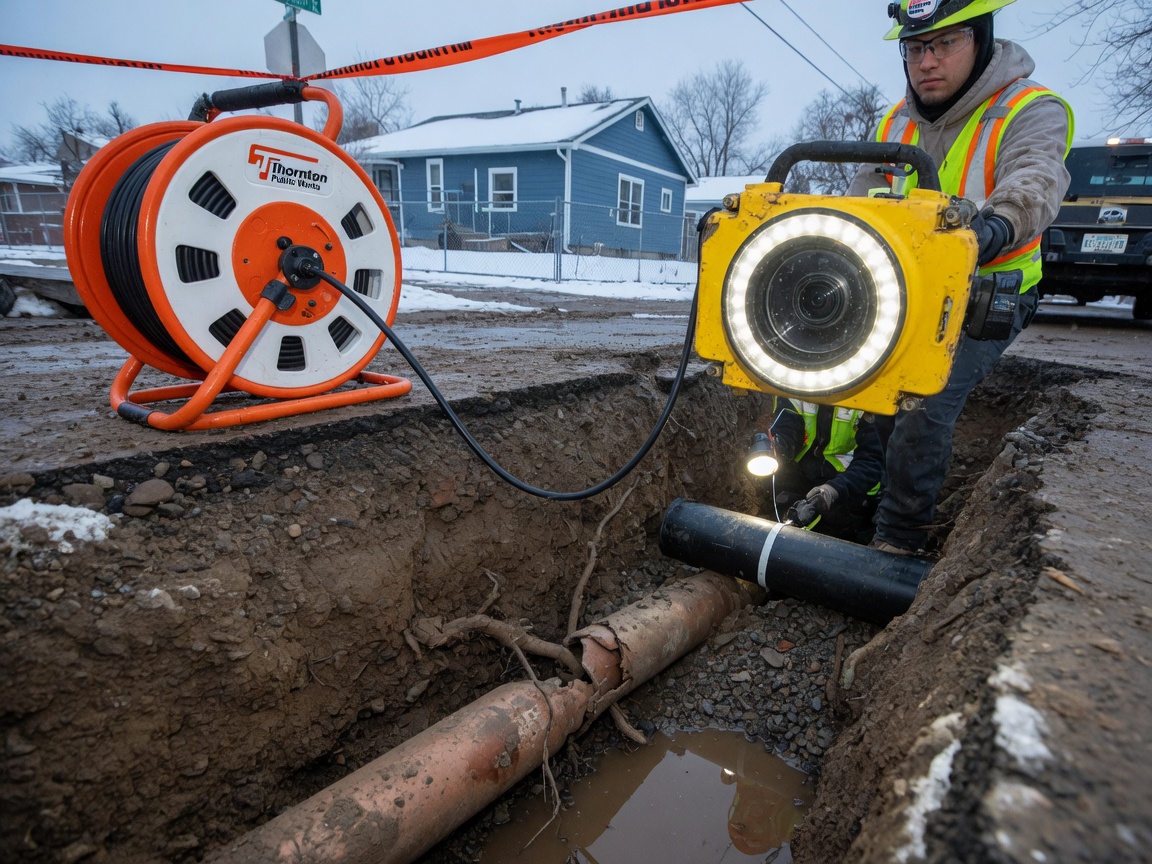
If more than one drain in the house is slow or backing up, the problem is probably not in a single sink. It is in the line that carries everything out to the city main. This page is for the homeowner who already knows something is wrong with the sewer line and wants to know how a repair gets decided. Short answer: the camera decides. Nobody should recommend digging up your yard before a camera has been run through the pipe. That is how we work: we run the camera first, explain what it shows, and put a written scope and price in front of you to approve before any work starts. For the earlier question of whether you have a single clog or a main line problem, read clogged drain or sewer line: how Thornton homeowners can tell.
Signs the sewer line is failing
The pattern matters more than any one symptom. Look for these:
- Two or more drains backing up at the same time, such as a toilet and a tub together.
- The lowest drain in the house goes first. In many homes that is a basement floor drain or basement shower, because sewage rises to the lowest opening.
- Gurgling in a tub or toilet when the washer or another fixture drains.
- A sewage smell in the basement, garage or yard.
- A soggy, sunken or unusually green patch in the yard along the path of the line.
- Backups that return within days after a cleaning.
If the last one describes your house, the cleaning cleared the water but not the cause. Roots, a sag or a broken joint will keep catching paper and grease.
What to do right now
Stop running water. That means no laundry, no dishwasher, no showers, and no flushing. Every gallon you send down has nowhere to go and will come up at the lowest drain. Do not pour chemical drain cleaners into a backed-up main line. They sit in standing water, do nothing about roots or a broken pipe, and are hazardous for whoever has to work on the line afterward. If sewage is already coming up in the house, keep people and pets out of that area and call (720) 856-5811, Monday to Saturday, 9am to 6pm. Until the line opens, keep water off. For more on backups, see emergency plumber.
What the camera run shows
A camera on a flexible cable goes in through a cleanout or other access point and travels down the line while we watch the picture and record it. Here is what we look for, and what each finding usually means.
- Roots at the joints. Clay pipe is laid in short sections with a joint every few feet. Roots find the tiny gaps at those joints, grow in, and catch paper. This is the classic cause of repeat backups in older clay.
- A belly. A low spot where the pipe has sagged and holds water. Waste settles in the belly instead of flowing on, so the line clogs again and again.
- An offset joint. Two sections have slid out of line, leaving a ledge that snags waste.
- A crack or break. Longitudinal or circular cracks let soil and roots in and sewage out.
- A collapse. The pipe has caved in, and the camera cannot get past it.
- Scale in cast iron. Old cast iron rusts from the inside and builds up rough scale that narrows the bore until it will barely pass flow.
The camera also tells us how far from the house the problem sits and how deep the line is. Those two numbers shape everything about the repair.
Spot repair, lining or full replacement
The finding points to the fix.
Spot repair fits a problem that is local: one broken joint, one short cracked section, one offset with the rest of the pipe sound. We dig down at that spot, replace that section and reconnect.
Lining (cured-in-place pipe) fits a line that is still in its original path and still runs downhill but has roots at several joints, hairline cracks or surface wear along its length. A resin-soaked liner is pulled into the pipe and cured to form a new pipe inside the old one. It needs little digging, but the host pipe has to be open enough to take the liner. It does not fix a belly, a bad offset or a collapse, since the liner follows the shape of the pipe it goes into. Roots are usually cut out with hydro jetting or a cutter before lining.
Full replacement fits a line that is collapsed, bellied, badly offset, or failing along most of its length. That can mean open trench, or pipe bursting, where a new pipe is pulled through the old path with less surface digging. Whether bursting is workable depends on what the camera shows, the pipe material, and where the access pits can go.
Root cutting and drain cleaning can buy time on a line with minor root growth, but they are maintenance, not a repair. Details on how we approach the job are on our sewer line repair page.
Thornton houses and Front Range soil
Home age is the first clue to what the camera will find. The Original Thornton area around 80229 was built out in the 1950s through the 1980s, and sewer laterals from that period are commonly clay or cast iron. Those are the materials most prone to root intrusion at joints and to internal scale. Newer construction in North Thornton, including 80602 and 80241, generally has PVC, which has fewer joints to attack and smooth walls, so a failure there is more often a single damaged or poorly bedded section.
The ground matters too. Front Range soils include expansive clay, and the Colorado Geological Survey documents how it swells when wet and shrinks when dry. That movement can shift buried lines, open joints and, over years, leave a sag where the pipe once ran straight. A belly on a Thornton line is not a mystery. It is what moving clay does to a gravity line.
Who is responsible, and what drives the cost
The City of Thornton wastewater collection staff maintain the city sanitary sewer system, meaning the mains. The line that serves your house is a private sewer service. The city's pages we found do not state exactly where private responsibility stops, so before assuming, confirm the boundary for your address with Thornton Utilities Operations at 720-977-6500. Do not assume the city will pay for a failed line without asking.
Cost is not one number, and we will not guess at one before the camera has been down the line. What moves it: how deep the pipe is, how long the failed section is, how easy it is to reach, what sits on top of it (a driveway, a patio, mature trees or landscaping), which method fits the finding, and whether the work reaches the street. The City of Thornton requires a permit for sewer service repair work, issued by either its Infrastructure Department or its Building Department, and lists repairs extending from the yard into the right-of-way under Infrastructure. If you are unsure whether the work reaches the right-of-way, the city directs applicants to 720-977-6210. Permits and street work add steps and time to a job, and they are part of the written scope you approve.
Call before you decide
You do not have to choose between a spot repair, lining and replacement before anyone has looked. Call (720) 856-5811. We run a camera through the sewer line, show you what it found, explain which of the three options fits, and give you a written scope and price to approve before work starts. If you are still unsure whether it is a sewer problem at all, start with clogged drain or sewer line: how Thornton homeowners can tell, or go straight to sewer line repair.